Tuesday, September 15, 2009

Rethinking this place

I started this little blogspot on a whim about four years ago as a way to get back to journaling. I never thought about getting rich and famous off of it as I know some have. I thought it would be an easy way to share a little about our life and to share pictures with people so I sent the link to my family and some friends. I try to keep this light-hearted and not post anything that is too controversial or questionable. Occasionally, my mom or a sister or Paul has suggested that I might need to reel in a post and they are usually correct.

I've generally tried to maintain privacy--I've never posted our last name or too much information about where we live. In regards to our jobs, I've never posted the name of my school or Paul's company. Some of the settings are private--it's not on the main blogroll or accessible with the next post button. It could be found from a search engine although I didn't intend for it to be and I changed that today. I don't post lots of pictures of Paul's family because while they might know about this place, I've never directly told them about it. Not trying to hide it; just never shared it with them. Because of this, I try to keep them out of it.

I think I have a steady stream of a dozen regular readers, most of whom I'm related to. I keep an eye on the site meter and while there are some IP addresses from locations where I don't know people, I've come to think of them as "regulars" and I think they're fairly safe or they've linked from a friend's blog. I've only had one anonymous person even try to start a fight with me in comments on something I've written in a post and that lasted all of two exchanges. When I joined Facebook, for some reason, I added the address of this blog to my main profile. I'm still trying to figure that one out. I guess I thought it was among friends and what could be the harm. I think a few friends checked it out but I didn't have a huge spike in my readership. I just went on with life and didn't think much of it.

Last week, a post I had written about my former school apparently touched a nerve. I've removed the post at the request of my former principal. I didn't mean for it to appear as negative and disgruntled about the school as apparently it did to some of my former coworkers. I was very frustrated by my job last year--I won't deny that. But I never meant to imply that my coworkers were bad. In fact, if one were to read posts in which I talked about applying for another librarian position, you would see that it was with some hesitancy that I was doing it. I did enjoy the majority of my coworkers. I do think most are doing a good job. Are there those that weren't? Heck yeah. Do I think that those same negative teachers exist at my new school? Definitely and I said as much in the now-removed post. While I didn't mean to sound as disgruntled as apparently I did, there were just things that *I* thought should be dealt with differently--most of which didn't directly affect my job but yeah, it affected my morale. I was feeling put-upon as a result. For *me* personally, it's hard to want to do a good job and be held to a high standard when it feels like there is an unequal treatment. I guess I'll sound a little bratty when I say it just wasn't fair. So, I did something about it and it's been a positive change for me. But no one should think that I'm going around badmouthing my former school--give me a little credit for that. If anything, it's quite the opposite and I'm fairly certain most of my new coworkers know I came from there and how proud I am to see so many former students who have "done good" in high school. Yeah, there are turkeys and I admitted to my new principal when seeing the name of one such turkey that that was probably the only child that I'd personally wanted to stuff in a trash can.

Back to Sitemeter and rethinking this place. Since what happened last week happened, and I'll admit that I messed up with a poorly written post, I'm a little gun-shy. I've also started to notice more Albuquerque accesses as well as several accesses from APS IP addresses. I'll admit to playing around reading blogs when I should be at work but not since this school year started. Am I feeling like I'm being watched, perhaps to see if I'll mess up again? Oh yeah. Am I worried that what I'm writing is being reported to others and not in a friendly "hey did you read that?" kind of way? Definitely. Paranoid, perhaps, but that's just how I am.

Paul and I were talking about it last night--about what to do about this place. I don't want to give it up completely because I do like being able to share stuff with my friends and family, especially during this time of our life and when The Most Amazing Child Ever is born. But I'm thinking about making it a private access place or just changing the location I keep it. I know other sites allow only some posts to be private access. I don't know if I'll actually do it before I get over myself and the paranoia I'm currently feeling. Heck, I should change this place to All Jub, All the Time. He is a rather interesting little creature. Maybe I'd feel better if everyone just gave a little shout-out in comments. I don't know if that would allay all my worries. I do know there are lots of possibilities about the future of The Blue-Eyed Bookworm.

For a little levity, I just had to add this video:

Monday, September 14, 2009

A mother's intuition

Today was another visit to the perinatologist for another sonogram and more measurements. This one was fantastic because I got to wear a mask through the whole thing--something they're asking of all patients during flu season. Hot and steamy and I could totally feel my rosacea acting up on my chin. And there's nothing I love more than having a bright red shiny chin. I'm not a believer that the mask is going to do much to prevent me getting the flu--that would come from concientious hand-washing and use of hand sanitizer when soap and water aren't available. Using tissues, sneezing into your elbow, etc. But I wore the mask while I was in the office. I cheated during the sonogram an pulled it out so I could breathe and the lower portion of my face could get air.

Nothing exciting about this visit. My weight is up an appropriate amount (2 lbs.), blood pressure was 90/64, pulse was 68. Baby's heart rate was 143. All the measurements were looking good. I'm 16 weeks and Baby's measuring right around 17 weeks. It took about 1.5 hours for the appointment because the baby kept moving around. I think I've felt Baby moving but people say it feels like fluttering. I don't feel fluttering. I am just momentarily aware that I have a uterus. Apparently, I'm giving birth to a soccer player though because that child is moving all around. Enjoy the room while you've got it, kid. Your mama is short and the space definitely won't last long. Baby is sitting really low right now too--the head is just above my cervix (which looked good--millimeters thinner than what the doctor wanted but because it was such a small margin, the techs didn't alert the doctor).

Unfortunately Paul got caught at work because I knew this would likely be the visit in which we could find out what flavor we're having. I told him that I wasn't going to find out because I wanted him to be there and I told the sonogram tech the same thing. The tech said she'd tell me when to close my eyes. I'd seen both Abigail's and Benjamin's sonogram pictures so I knew vaguely what girl parts and boy parts look like on the sonogram screen. At one point today, I thought she was looking at the head (she had been so it's a natural thought) and I asked if what I was looking at was the eye sockets. Apparently, Baby had moved and we were then looking at the bottom end. So, I wasn't really concerned that I would know what I was looking at on the screen

Then Baby flipped again and I said, "Oh. That looked like boy parts."

I will give the sonogram tech credit in that she said absolutely nothing. A second tech came in to do some other pictures and asked if we were finding out. By this point, I was fairly certain as to what I'd seen. I had to go to the bathroom and told them that I thought I'd call Paul to see what he thought. When I was back in the exam room with Paul on the phone, I told him that the tech knew and I thought I knew but she would tell me. He agreed to just find out and she confirmed that I had indeed seen what I thought I saw. Paul laughed and said, "Oh, no. Now we have to worry about things being destroyed." That's the attitude, honey. One of his coworkers said that at least we only had to worry about one penis and not lots of penises. Nothing but support, those engineers.

So my dream was right--perhaps my first taste of mother's intuition. This baby is going to be a boy. Not just any boy--the first firstborn son on for my mom's side of the family since my grandfather was born over 80 years ago. We don't have many boys in the family--we're definitely heavy on the estrogen at family reunions and the boys in the family are either the second or third child. Not that it will make him any more special than any of the other babies born during that time. He's just proof that a son can be born first. While I was thinking of this, I also thought "Poor Sarah." I don't know if she wanted a girl cousin or if it even mattered to her but a part of me wanted another girl for her in Paul's family.

Here is 16 weeks. Looking a little more rounded although mostly just chubby still. And I really should take these earlier in the day. I'm smaller in the morning but at least then I'm wearing makeup and don't look so scary.


Jub at 16 weeks. I always think he looks a little drunk when he sits like this.

Friday, September 11, 2009

To remember

Several years ago, I purchased a book for the library called To Reach the Clouds by Phillipe Petit. This was after the events of 9/11/2001 and I think I was looking for a positive story about The Twin Towers. I also purchased a picture book called The Man who Walked Between the Towers, the Caldecott winner for 2004, as a companion to the book. I was unfamiliar with the story of this high-wire walk between the twin towers. It took place 3 months before I was born and I don't remember hearing any mention of it until that tragic day in history. Perhaps it was overshadowed by the events two days later--a far more historic moment in U.S. history--or it was just lost in the annals of history. Whichever, it was a moment in history in which the World Trade Center was the center of attention and for much happier reasons.

Tonight, Paul and I watched the documentary Man on Wire which won the Academy Award for Best Documentary this year. Paul had ordered it from Netflix and was telling me about it--I think he was surprised that I knew what the story until I mentioned the books. It is an extremely well done movie, mixing old film footage and photographs with interviews of the main participants. It was unintentional that we watched the movie tonight--it came today and there wasn't anything else on TV that we wanted to watch. I think it was a fitting tribute to watch this film in regards to the events of 2001--to watch the towers being built and to hear the stories told about the events 35 years ago when the Twin Towers were the tallest buildings in the world and they dwarfed the New York skyline--when the worst thing to be considered was a crazy Frenchman walking between them for 45 minutes.

Friday, September 4, 2009

A more positive library story

It is an interesting profession that I've chosen given that technology is constantly changing the way we look for information. I will argue that librarians are/always will be a vital link in navigating those changing waters and helping patrons/customers locate what they need on the Google or the Internets and in electronic databases. We spend quite a bit of time training to do just that. I still say that books are a very valid way to find information, especially in the early stages of research and at the level of students with which I deal. One of my focuses now at the high school is teaching students to use electronic databases to find information and how to appropriately and accurately find information using search engines.

In my graduate classes, we've spent quite a bit of time in the two semesters I've taken discussing Library 2.0. One of the classes I'm taking this semester is about technology in the library. The first discussion topic is "Good vs. Bad Technology." I frequently think about how different my classes and my degree would have been had I originally gone to graduate school for my MLS after graduating from Tech as I had planned. Twelve years ago, the Internet was a wee shadow of what it is now and so much of the technology and information that we use wasn't even being considered. This is definitely a position that is evolving and changing with the times. And I'm enjoying all of it.

http://www.cnn.com/2009/TECH/09/04/future.library.technology/index.html

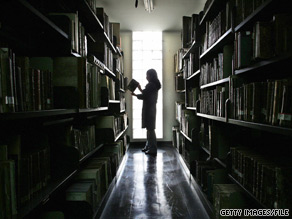
The future of libraries, with or without books


(CNN) -- The stereotypical library is dying -- and it's taking its shushing ladies, dank smell and endless shelves of books with it.
Libraries are trying to imagine their futures with or without books.

Libraries are trying to imagine their futures with or without books.

Books are being pushed aside for digital learning centers and gaming areas. "Loud rooms" that promote public discourse and group projects are taking over the bookish quiet. Hipster staffers who blog, chat on Twitter and care little about the Dewey Decimal System are edging out old-school librarians.

And that's just the surface. By some accounts, the library system is undergoing a complete transformation that goes far beyond these image changes.

Authors, publishing houses, librarians and Web sites continue to fight Google's efforts to digitize the world's books and create the world's largest library online. Meanwhile, many real-world libraries are moving forward with the assumption that physical books will play a much-diminished or potentially nonexistent role in their efforts to educate the public.

Some books will still be around, they say, although many of those will be digital. But the goal of the library remains the same: To be a free place where people can access and share information.

"The library building isn't a warehouse for books," said Helene Blowers, digital strategy director at the Columbus [Ohio] Metropolitan Library. "It's a community gathering center."

Think of the change as a Library 2.0 revolution -- a mirror of what's happened on the Web.

Library 2.0

People used to go online for the same information they could get from newspapers. Now they go to Facebook, Digg and Twitter to discuss their lives and the news of the day. Forward-looking librarians are trying to create that same conversational loop in public libraries. The one-way flow of information from book to patron isn't good enough anymore.

Greenwalt, for example, set up a Twitter feed and text-messaging services for his library. He monitors local conversations on online social networks and uses that information as inspiration for group discussions or programs at the real-world library."We can pick up on all of these trends that are going on," said Toby Greenwalt, virtual services coordinator at the Skokie Public Library in suburban Chicago.

Other libraries are trying new things, too.

The Public Library of Charlotte and Mecklenburg County, in North Carolina, has a multimedia space where kids shoot videos and record music. It also runs a blog dedicated to gaming and hosts video game tournaments regularly.

Kelly Czarnecki, a technology education librarian at ImaginOn, a kids' branch of that library, said kids learn by telling their own stories.

"Our motto here is to bring stories to life, so by having the movie and music studio we can really tap into a different angle of what stories are," she said. "They're not just in books. They're something kids can create themselves."

Czarnecki believes that doesn't have to come at the expense of book-based learning.

The Aarhus Public Library in Aarhus, Denmark, takes things a step further.

The library features an "info column," where people share digital news stories; an "info galleria" where patrons explore digital maps layered with factoids; a digital floor that lets people immerse themselves in information; and RFID-tagged book phones that kids point at specific books to hear a story.

"The library has never been just about books," said Rolf Hapel, director of the city's public libraries.

Community Centers

Jason M. Schultz, director of the Samuelson Law, Technology and Public Policy Clinic at the University of California at Berkeley Law School, said libraries always have served two roles in society: They're places where people can get free information; and they're community centers for civic debate.

As books become more available online, that community-center role will become increasingly important for libraries, he said.

"It depends on whether we prioritize it as a funding matter, but I think there always will be a space for that even if all the resources are digital," he said.

Some libraries are trying to gain an edge by focusing on the "deeply local" material -- the stuff that only they have, said Blowers, the librarian in Ohio.

"How do we help add that value to a format like the Internet, which is expansively global?" she said. "So we look at what do we have here that we could help people gain access to by digitizing it."

That material can be used to start community discussions, she said.

Librarians

This shift means the role of the librarian -- and their look -- is also changing.

In a world where information is more social and more online, librarians are becoming debate moderators, givers of technical support and community outreach coordinators.

They're also no longer bound to the physical library, said Greenwalt, of the library in Skokie, Illinois. Librarians must venture into the digital space, where their potential patrons exist, to show them why the physical library is still necessary, he said.

A rise in a young, library-chic subculture on blogs and on Twitter is putting a new face on this changing role, said Linda C. Smith, president of the Association for Library and Information Science Education.

Some wear tattoos, piercings and dress like they belong on the streets of Brooklyn instead of behind bookshelves. They're also trying on new titles. Instead of librarians, they're "information specialists" or "information scientists."

Libraries like the "Urban Media Space," which is set to open in 2014 in Aarhus, Denmark, are taking on new names, too. And all of that experimentation is a good thing, Smith said, because it may help people separate the book-bound past of libraries from the liberated future.

"It's a source of tension in the field because, for some people, trying to re-brand can be perceived as a rejection of the [library] tradition and the values," she said. "But for other people it's a redefinition and an expansion."

Funding woes

In the United States, libraries are largely funded by local governments, many of which have been hit hard by the recession.

That means some libraries may not get to take part in technological advances. It also could mean some of the nation's 16,000 public libraries could be shut down or privatized. Schultz, of the Berkeley Law School, said it would be easy for public officials to point to the growing amount of free information online as further reason to cut public funding for libraries.

Use of U.S. public libraries is up over the past decade, though, and many people in the information and libraries field say they're excited about opportunities the future brings.

"I came into libraries and it wasn't about books," said Peter Norman, a graduate student in library and information science at Simmons College in Boston who says he's most interested in music and technology. "Sure I love to read. I read all the time. I read physical books. But I don't have the strange emotional attachment that some people possess."

"If the library is going to turn into a place without books, I'm going to evolve with that too," he said.

Thursday, September 3, 2009

Why the perinatologist?

I guess there are some portions of this pregnancy thing that I've skipped over because it was happening when we still weren't talking about it (when it was only the worst kept secret in the world). Here's the scoop on the perinatologist.

Some background to begin--in November 2003, I went in for my annual gynecological exam and afterwards, I had a call from the doctor that the Pap smear was abnormal and that I'd need to schedule a follow-up procedure. I think she told me there was a chance of cervical dysplasia and the follow up procedure, a colposcopy, was needed to confirm the diagnosis and determine the severity of the dysplasia as well as how many spots there were. Since the dysplasia was caught early enough (a definite benefit to having annual Pap smears), all that was needed was a LEEP procedure which occurred in January 2004. It was an in-office treatment and Paul came with me. I probably would have been fine to go by myself but the moral support was definitely necessary. It was a pretty uneventful procedure, everything went well, and I relaxed the rest of the day, acutely aware for the first time of where my cervix was actually located.

At the follow-up, the doctor said that it had been a smallish spot and the edges had been clear so all that would be needed would be Pap smears every three months for the first year, every six months the second year, and annually afterwards. Except that after the first year, I was still getting abnormal Paps back so I had to continue the every three months thing for longer--maybe 18 months. I don't really remember. Just when we were thinking things were going to be OK, during the summer of 2006, a Pap smear revealed abnormal cells from my uterus and I got to have an intrauterine swab.

I cannot say how excruciatingly painful this procedure was. The doctor said that I'd probably only need about four Advil beforehand to give me a little relaxer but it was a quick procedure--less than 10 minutes--so he wouldn't give me anything else. Short but he didn't mention the B-A-D bad part. Basically, the doctor takes a swab and runs it up through the cervix, all the way up into the lower part of uterus and starts scraping. You know how a normal Pap feels--a little pinching? That but MUCH worse. My uterus pretty much revolted and started cramping, HARD and sharply, pretty much immediately. It was 10 of 10 pain and I was crying almost immediately because of it. I know my discomfort was really bothering Paul. I think even Paul was ready to tell the doctor to stop it, it's not worth this. The doctor and nurse were both telling me to lie still, just breathe through it, Paul was doing his best to keep me still and calm, and all I wanted to do was get out of there. The doctor said he didn't know if he had gotten enough cells but if we had to do it again, he'd give me anesthesia. I think I'd requested Valium or some such drug beforehand and I think he thought I was joking. Paul told me afterwards that the next time the doctor told me it was going to be something a few Advil would work for, to ram my head into the wall repeatedly until I knocked myself out. Thankfully there were enough cells and the test came back negative. Subsequent Pap smears also came back clear and finally, the past two years have had clear Pap smears. (That's really not part of the story; I just wanted a little sympathy for what I went through.)

So, the perinatologist--

At the doctor's visit in July for the pregnancy confirmation, the doctor gave us a few minutes together before he came in with all the rest of the information for us. I don't know if that is his standard practice but it was appreciated since we were jet-lagged and emotional. Then all the bucket-loads of information came at us. He recommends no caffeine the first trimester, limit cold cuts and soft cheeses, sushi is out in his opinion. He's a single practitioner so we'll need to see someone else, here's the name of the doctor and practice he's referring OB patients to. Oh, yeah, you had the LEEP and you'll be 35 when Baby is born so you're of advanced maternal age, we'll schedule an appointment with the perinatologist for genetic screening and monitoring. Keep taking vitamins. And, oh yeah, congratulations. Let us know when Baby is born.

The perinatologist visit was three weeks later and we met with a genetic counselor. Paul and I have very few, if any, indicators of genetic anomalies that we needed to worry about and since we're pretty much the last people having children in our families, we knew that there had been nothing for anyone earlier. Neither of our mothers could remember any incidences that might be cause for concern. We opted for the level 2 screening which requires two blood draws to rule out the possibility of chromosomal abnormalities, a spinal abnormality, and cystic fibrosis. There was also a sonogram to take measurements of Baby, who was being most uncooperative, including the nuchal fold at the base of the neck which can be an indicator of chromosomal abnormalities. So far, everything looks good (except for an already stubborn child). That was the perinatologist visit for the advanced maternal age side of things.

Because of the LEEP procedure and the fact that I have scar tissue on my cervix, there is a *slight* chance that my cervix could become compromised. I'll continue to see the perinatologist every month until at least 20 or 24 weeks to monitor the condition of my cervix. I'll alternate visits every two weeks with the perinatologist and the OB/GYN. The OB/GYN said that he'd "spring" me from the perinatologist's office after my last screening work was done (I can't remember if that is 20 or 24 weeks) because he's seen very little that indicates the cervix will compromise after 20 weeks. While it's a pain to go to a doctor's office that much, it is fun to get to see pictures of Baby all the time (I've had three sonograms already). I don't know what we're going to do yet--we've got at least 6 weeks to decide. In the meantime, I'm glad that I've got people watching this to make certain things stay like they should.